
-
- Energy storage hydraulic control system with reliable energy monitoring
- Energy storage high-flow hydraulic forming system
- High-precision digital servo synchronous actuation system
- Energy storage high-flow electro-hydraulic servo test system
- Energy storage, large flow compensation and balance hydraulic control system
- High-frequency fatigue testing system
-
-
- Product
-
Solution
-
Energy storage hydraulic control system with reliable energy monitoring
- Energy storage high-flow power source start-up system
- Energy-saving electro-hydraulic control system
- Hydro-controlled system of electric furnace energy storage device power source
- Emergency control high-pressure accumulator power source for valves
- Governor energy storage power source electro-hydraulic control system
-
Energy storage high-flow hydraulic forming system
-
High-precision digital servo synchronous actuation system
-
Energy storage high-flow electro-hydraulic servo test system
-
Energy storage, large flow compensation and balance hydraulic control system
- High-frequency fatigue testing system
-
Energy storage hydraulic control system with reliable energy monitoring
- Service
- Calculation
In a hydraulic circuit with multiple accumulators connected in parallel, if one bladder ruptures, will the other accumulators experience any change in volume?


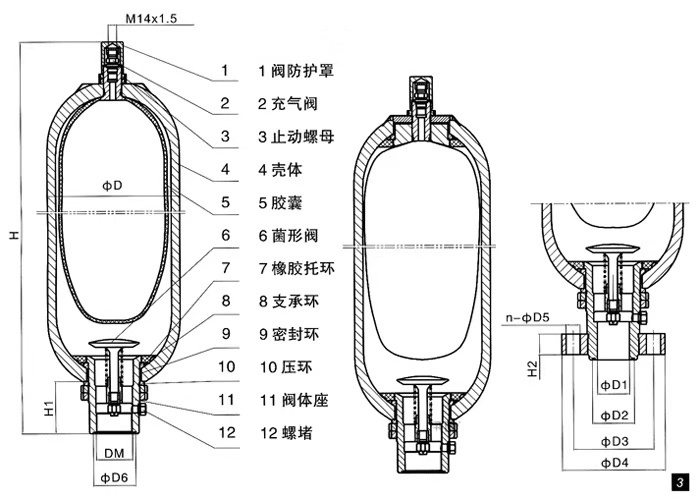
Under normal operating conditions, if the system maintains continuous oil supply and the system pressure remains constant, the rupture of one accumulator bladder will not alter the total volume of the other accumulators connected in parallel. This is because the bladder’s volume (shown as item 5 in the figure) depends solely on the pre‑charged gas pressure and the system’s working oil pressure—the pressure within the pipe indicated by DM. When the system is idle, the oil pressure is nearly zero; under the action of the pre‑charged gas pressure, the bladder (5) expands fully, and the poppet valve (6) seats against its seat. Once the system starts operating and the oil pressure exceeds the pre‑charged gas pressure, the poppet valve (6) opens, allowing hydraulic fluid to enter the accumulator and compress the bladder. As the gas is compressed, the pressure inside the bladder rises until it balances with the oil pressure. Consequently, if one accumulator bladder ruptures, hydraulic fluid enters the bladder and mixes with the gas. The fluid is supplied by the pump; as long as the pump delivers oil promptly at the moment of rupture, the oil pressure will not drop, and the volumes of the other accumulator bladders remain unchanged. However, if the pump can only maintain a minimal flow rate, the oil pressure will decrease, causing the volumes of the other bladders to adjust—typically increasing—but the system can still function to some extent. As for the stroke length mentioned by the questioner, it will not be affected by a bladder rupture, provided that the control valve or the pump continues to deliver the same volume and flow rate of hydraulic fluid to the actuator; under these conditions, the working stroke remains unaffected.
However, the dangers posed by a ruptured casing should not be overlooked. Let us analyze this:
When the bladder of an accumulator ruptures, hydraulic fluid enters the bladder and mixes with the gas. In a favorable scenario, the gas coalesces inside the accumulator; in a more severe case, the gas is carried out by the fluid: if it enters a valve, it can produce a whistling noise; if it reaches a cylinder or motor, the rapid reduction in the fluid’s bulk modulus due to the gas–fluid mixture degrades the dynamic performance of the actuating mechanism; if it enters the reservoir, and the reservoir is sealed, it may cause sudden pressurization, resulting in abnormal noises or even rupture; and if it enters a pump or motor, it can further break down into fine foam, leading to a rapid deterioration in fluid quality and necessitating an oil change.
Therefore, regarding the frequent rupture of bladder accumulators mentioned by the questioner, it is essential to investigate the root cause. First, assess whether the selection process failed to account for the system’s operating conditions—for example, whether the system frequently experiences large‑scale charging and discharging cycles, rapid pressure release events, or excessively high transient pressures. A ruptured bladder indicates bladder failure, typically resulting from reaching the fatigue‑failure limit of the bladder material. If the operating conditions align with these scenarios, consider switching to a piston‑type accumulator to prevent recurrence.
Accumulators are highly intriguing components in hydraulic systems, analogous to capacitors in electrical circuits or springs in mechanical systems. They serve as critical energy‑storage elements, enabling a wide range of sophisticated functions—such as hybrid power applications, shock absorption, pressure stabilization (and sometimes flow‑rate regulation), and the rapid release of stored energy to simulate impact loads.
Hotline
Address: Building 39B, Floor 1, No. 16, Huanke Zhong Road, Tongzhou Park, Zhongguancun Science and Technology Park, Tongzhou District, Beijing
Which application field are you looking for solutions in?
Alternating Stress High-Frequency Fatigue Testing System
This product is a new generation of intelligent wireless sensor detectors upgraded and developed by our company. It is powered by active power supply and uses LoRa for local area networking. The effective transmission distance is far and the reliability is high. At the same time, it can be used for distributed networking layout environmental gas monitoring according to different environmental conditions, greatly reducing users' construction costs and complex data wiring. Through the edge gateway, data is uploaded to the cloud or intranet security control center via 4G, RJ45, and RS485 bus...
Energy-Storage High-Flow Ejection Hydraulically Controlled Test System
This product is a new generation of intelligent wireless sensor detectors upgraded and developed by our company. It is powered by active power supply and uses LoRa for local area networking. The effective transmission distance is far and the reliability is high. At the same time, it can be used for distributed networking layout environmental gas monitoring according to different environmental conditions, greatly reducing users' construction costs and complex data wiring. Through the edge gateway, data is uploaded to the cloud or intranet security control center via 4G, RJ45, and RS485 bus...
Energy-Storage High-Flow Pulse Impact Test System
This product is a new generation of intelligent wireless sensor detectors upgraded and developed by our company. It is powered by active power supply and uses LoRa for local area networking. The effective transmission distance is far and the reliability is high. At the same time, it can be used for distributed networking layout environmental gas monitoring according to different environmental conditions, greatly reducing users' construction costs and complex data wiring. Through the edge gateway, data is uploaded to the cloud or intranet security control center via 4G, RJ45, and RS485 bus...
Constant-Flow Energy Storage Power Source Test System
This product is a new generation of intelligent wireless sensor detectors upgraded and developed by our company. It is powered by active power supply and uses LoRa for local area networking. The effective transmission distance is far and the reliability is high. At the same time, it can be used for distributed networking layout environmental gas monitoring according to different environmental conditions, greatly reducing users' construction costs and complex data wiring. Through the edge gateway, data is uploaded to the cloud or intranet security control center via 4G, RJ45, and RS485 bus...
Inquire Now
If you have any questions during the use of our products and services, please feel free to leave a message. We value your feedback and opinions.
Products of Different Specifications
Products
Application Fields
Application
Partners
Partner
Exporting Countries and Regions
Exported Countries
Schwerll Fluid Control (Beijing) Co., Ltd.
Email: schwerlltec@schwerll.com.cn
Address: Building 39B, Floor 1, No. 16, Huanke Zhong Road, Tongzhou Park, Zhongguancun Science and Technology Park, Tongzhou District, Beijing
Welcome to access our company through the following methods
Copyright © 2024 Schwell Energy Storage Technology (Beijing) Co., Ltd.